I Made These FREE Vintage Recipe Tools JUST For You
This recipe was created with help from AI tools and carefully reviewed by a human. For more on how we use AI on this site, check out our Editorial Policy. Classic Fork earns a small commission from Amazon and other affiliate links at no extra cost to you, helping us keep our content free and honest.
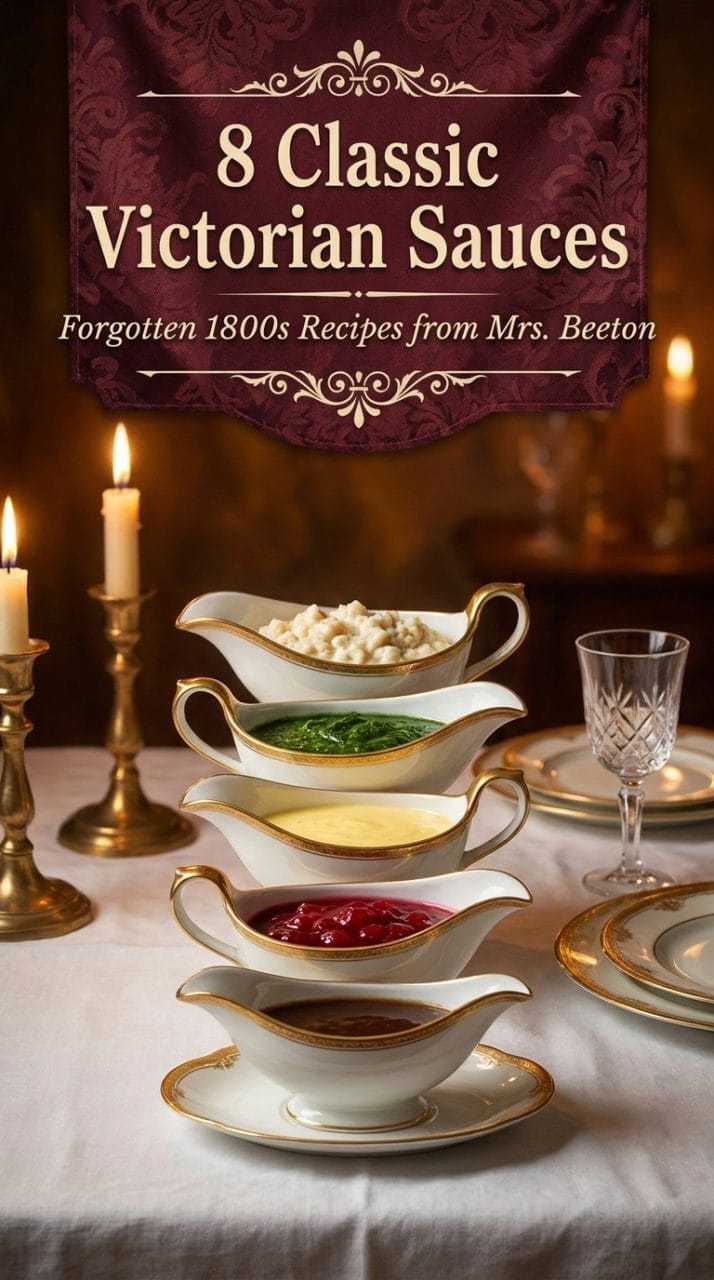
Classic Victorian Sauces: 8 Forgotten Sauces Every 1800s Cook Knew
Victorian dinner tables ran on sauces. The 1800s British cook was not allowed to put a piece of meat on a plate without a hot, glossy sauce poured over it.

Mrs. Beeton’s Book of Household Management (1861) lists over 200 sauces. Eliza Acton’s earlier Modern Cookery (1845) covered nearly as many. They were the backbone of every middle-class kitchen, and most of them have been quietly forgotten.
Here are 8 classic Victorian sauces worth bringing back, what they were poured over, and why they ended up on every Victorian table from London to Liverpool.
1. Bread Sauce
The Victorian classic that survived into the 21st century mostly because Christmas roast turkey will not let it die.
Bread sauce is white, thick, gently spiced with cloves and onion, and made by simmering breadcrumbs in milk infused with an onion studded with cloves. Mrs. Beeton called it “the proper accompaniment to roast game and fowl.” It is still that. Pour it over roast chicken, partridge, or any roast bird that needs softening.
2. Mint Sauce
The non-negotiable companion to roast lamb in Victorian Britain.
Three ingredients: fresh mint, sugar, white wine vinegar. Chop the mint very fine, dissolve the sugar in the vinegar, pour the vinegar over the mint, let it sit for 30 minutes. The Victorian recipe used 2 tablespoons of mint to 4 tablespoons of vinegar and 2 teaspoons of sugar. Modern jars cut the sugar back. The original was sweeter and thinner than what comes in a Colman’s bottle today.
3. Cumberland Sauce
A late-Victorian addition (1880s) that became a permanent fixture on cold-meat platters.
Redcurrant jelly melted with port wine, orange and lemon zest, mustard, and a pinch of cayenne. Served cold over cold ham, cold game, or cold venison. The combination of fruit, citrus, and heat is one of those Victorian inventions that sounds odd on paper and works on the plate.
4. Hollandaise (Just Becoming Popular)
Hollandaise was a French import that started showing up in English cookbooks in the 1830s and was firmly mainstream by 1870.
Egg yolks, lemon juice, butter, salt, cayenne. Whisked over a gentle bain-marie until the sauce thickens. Victorian cooks called it “Dutch sauce” and served it over poached fish, asparagus, or Victorian eggs Benedict (yes, that was already a thing).
5. Caper Sauce
The classic accompaniment to boiled leg of mutton. Now mostly forgotten because nobody boils a leg of mutton anymore.
The base was a white roux of butter and flour, thinned with the mutton broth, finished with a generous spoonful of capers and their pickling vinegar. The Victorians built it into the cooking water of the meat itself, dipping out broth as the joint cooked. The sauce came together while the mutton was carved.
6. Anchovy Sauce
If you have ever wondered why Worcestershire sauce tastes vaguely fishy, anchovy sauce is the reason. Victorian cooks used pounded salted anchovies in white sauces over fish, lamb chops, or steak.
The recipe was a basic white sauce with 4 to 6 anchovies pounded into a paste and stirred in. The fish dissolved completely and left a deep umami background that Victorian palates loved. It was the original “savory bomb” sauce a century before the word umami existed in English.
7. Mushroom Ketchup

Tomato ketchup was a late-Victorian American import. The original Victorian “ketchup” was made from mushrooms.
The process: salt mushrooms heavily, let them sit for 24 hours, press out the dark juice, simmer the juice with cloves, mace, and pepper, bottle it. The result was a black, salty, intensely savory liquid you could splash into stews, gravies, or meat marinades. It is still made by some specialty British producers and tastes nothing like the red sauce that stole the name.
8. Brandy Butter (Hard Sauce)
The classic Victorian Christmas pudding sauce. Also called “hard sauce” in American cookbooks of the era.
Butter, sugar, brandy, beaten together until pale and fluffy. Spooned cold onto hot Christmas pudding, where it melts into a buttery, boozy puddle. Victorian recipes used unsalted butter, caster sugar, and a tablespoon of brandy per quarter-pound of butter. Modern versions are sometimes shortcut with rum or whisky.
Why Victorian Sauces Vanished
Three things happened in the early 20th century that killed the Victorian sauce repertoire:
- WWI rationing made the butter, eggs, and cream that most Victorian sauces required suddenly impossible to source
- Mass-produced bottled sauces (HP Sauce 1903, ketchup imported from the US, Worcestershire sauce in every shop) replaced the daily made-from-scratch versions
- The decline of the cook-at-home middle class meant fewer households had a daily cook with the time to make a roux at every meal
By 1950, most British households knew bread sauce and mint sauce only because they showed up at Christmas and Easter. The other six on this list quietly slid out of everyday cooking and into history.
Mrs. Beeton vs Eliza Acton
Mrs. Beeton (1861) is the better-known sauce reference today, but Eliza Acton’s Modern Cookery for Private Families (1845) is technically the more reliable source. Acton actually tested her recipes. Beeton compiled hers, sometimes from Acton’s book without crediting her.
If you want the real Victorian sauce, work from Acton. If you want the version that conquered popular memory, work from Beeton. Both books are in the public domain and free to read online.
Where to Use These Today
Most Victorian sauces still pair with foods you eat now:
- Bread sauce on a roast Sunday chicken
- Mint sauce on lamb chops
- Cumberland on a charcuterie board
- Hollandaise on weekend eggs Benedict
- Mushroom ketchup splashed into beef stew
- Brandy butter on Christmas pudding
Our own Victorian gingerbread, Victorian milk bread, and Victorian seed cake recipes show what these sauces were poured over at the supper table.