Classic Fork earns a small commission from Amazon and other affiliate links at no extra cost to you, helping us keep our content free and honest.
Revolutionary War Recipes: 8 Authentic 1770s Dishes Soldiers and Settlers Ate
Time Period:
Meal Type:
The Revolutionary War lasted from 1775 to 1783, and what people actually ate during those years tells a story textbooks usually skip.
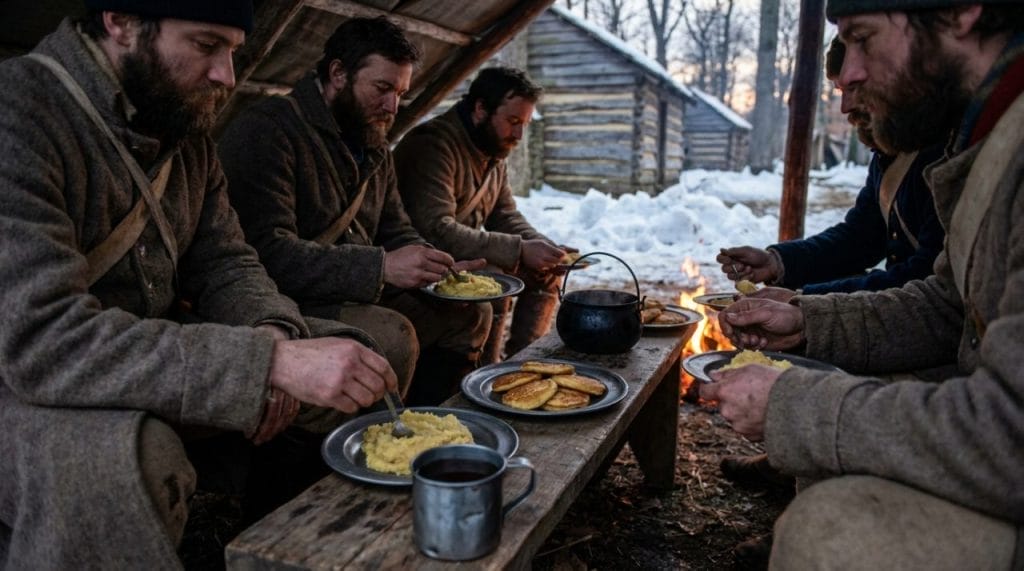
Continental soldiers survived on hasty pudding and pepper pot soup. Boston households boycotted British tea and switched to homemade switchel and cider. Pennsylvania farmers fed the Army the way they fed themselves: with cornmeal, salt pork, dried beans, and whatever the woodlot gave up.
These 8 recipes are the real thing. Each one is documented from a 1770s diary, military ration list, or pre-1800 cookbook, and each is still cookable in a modern kitchen with one small adjustment.

1. Philadelphia Pepper Pot Soup (“The Soup That Won the War”)

December 1777, Valley Forge. The Continental Army was starving in the snow.
According to period accounts, a Philadelphia cook attached to the army was given whatever could be scrounged: tripe, a few bones, scraps of vegetables, and a fistful of black peppercorns. He turned it into a thick, peppery soup that fed thousands of soldiers and earned credit for keeping the Army alive through one of the darkest stretches of the war.
The original used tripe, but a beef-and-bone version is closer to what most modern cooks will actually make. Get the full Pepper Pot Soup recipe.
2. Hasty Pudding (Continental Army Ration Staple)
Joel Barlow, the American poet and diplomat, wrote a 400-line poem about hasty pudding in 1793. He grew up eating it during the Revolution and could not let it go.
It was the Continental Army’s ration staple for a reason. Cornmeal, water, salt, a pat of butter or a drizzle of molasses (Grandma's Unsulphured is the only kind I trust). Cooked in an iron pot over a fire in 20 minutes. Filling, cheap, and nearly impossible to ruin.
Get the Colonial Hasty Pudding recipe with the modern oven version.
3. Johnny Cakes (The Soldier’s Saddle-Bag Bread)
Cornmeal, salt, water, hot griddle. That is the entire Revolutionary recipe.
Continental soldiers carried a hand-sized bag of cornmeal in their packs. When the order came to halt, they mixed a flat batter on a piece of bark, cooked it on a heated rock or a flat griddle, and ate it within an hour. The name “johnny cake” was likely a corruption of “journey cake,” the bread you took on a journey.
Get the Colonial Johnny Cakes recipe.
4. Colonial Indian Pudding (1777 Thanksgiving Standard)
The first national Thanksgiving was declared by the Continental Congress on December 18, 1777, after the American victory at Saratoga. Indian pudding was on every New England table that day.
The recipe is colonial through and through: yellow cornmeal (“Indian meal”), molasses, milk, butter, and a long slow bake until the pudding is brown and set. Get the Colonial Indian Pudding recipe.
5. Pumpkin Pie, Colonial Style (1770s Original)
The 1770s pumpkin pie was not the smooth, sugary version on a modern Thanksgiving table.
The original used pumpkin stewed with apples, sweetened with molasses, spiced with whatever the household could afford (usually nutmeg and ginger), and baked in a thick, lardy crust. Eggs were optional. Cream was a luxury. The flavor is darker, less sweet, and more like a savory squash custard than a modern pie.
Get the Colonial-Era Pumpkin Pie recipe.
6. Roast Turkey, Colonial Style
By 1775, wild turkey had been on Eastern Seaboard tables for nearly 150 years. The 1777 Thanksgiving order called specifically for roasted turkey and pumpkin pie as the centerpiece dishes.
Colonial roasting meant a turkey turned slowly on a spit in front of an open fire for 3 to 4 hours, basted continuously with butter or pan drippings. The skin came out crackly and dark. The meat stayed juicy in a way modern oven roasting struggles to match. Get the Colonial Roast Turkey recipe, adapted for a modern oven.
7. Succotash (Native American + Colonial Fusion)
Succotash predates the Revolution by centuries. It is a Narragansett dish, “msickquatash,” meaning broken corn kernels.
By the 1770s it was a staple of Continental Army meals because the ingredients (corn, beans, sometimes salt pork) were cheap, durable, and grew everywhere. The Revolutionary version was thick, savory, and ate like a stew. Get the Colonial Succotash recipe.
8. Sally Lunn Buns (Imported From Bath, Loved in Williamsburg)
The Sally Lunn was carried across the Atlantic from Bath, England, in the early 1700s and made it into the kitchens of Charleston, Williamsburg, and Annapolis well before the Revolution started.
By 1775 it was a fixture of Colonial tea tables, sliced thin, smeared with butter, and served alongside whatever sweet preserve was in season. The bread is enriched with eggs and milk, baked tall in a fluted mold, and torn apart at the table. Get the Sally Lunn Bun recipe.
What Continental Soldiers Actually Ate (Daily Ration)
The official Continental Army ration set by Congress on November 4, 1775, was generous on paper:
- 1 pound of beef OR 3/4 pound of pork OR 1 pound of salt fish per day
- 1 pound of bread or flour per day
- 3 pints of beans, peas, or vegetables per week
- 1 pint of milk per day
- 1 quart of beer or cider per day
- A spoonful of vinegar (anti-scurvy)
In practice, the ration almost never arrived in full. Soldiers supplemented with hasty pudding made from foraged cornmeal, johnny cakes cooked on rocks, and pepper pot soup made from anything that could be put in a pot.
A Note on Authenticity
Every recipe linked above keeps the original 1770s technique and ingredient list, with the bare minimum of modern adjustments to make them work in a 21st-century kitchen.
If you want to go deeper, our guide to popular sweets during the American Revolution covers what colonists ate after dinner. For the broader 18th-century picture, see the 5 Colonial 18th-century recipes roundup.

Maggie Hartwell
Hi there, I’m Maggie Hartwell, but you can call me Maggie—the apron-clad foodie behind Classic Fork! I created Classic Fork because I’m convinced food has a way of telling stories that words can’t. So, grab a fork and dig in. The past never tasted so good!


