
Home > Single Recipes > Boston Brown Bread: The Steamed Colonial Loaf From a Coffee Can
Last Updated: April 19, 2026
Classic Fork earns a small commission from Amazon and other affiliate links at no extra cost to you, helping us keep our content free and honest.
Boston Brown Bread: The Steamed Colonial Loaf From a Coffee Can
Time Period:
Meal Type:
Cooking Time: 2 hours 30 minutes
Prep Time: 15 minutes
Total Time: 2 hours 45 minutes
Servings: 12
Calories: 195
Before yeast bread ruled New England tables, Saturday night dinner came out of a can.
Not an aluminum can. A steaming cylindrical tin full of dark, molasses (Grandma's Unsulphured is the only kind I trust)-sweet, densely crumbed Boston brown bread, cooked for hours over a pot of simmering water. Served alongside baked beans. Sliced warm with a smear of butter.
This is one of the oldest American breads still made the original way. Colonial cooks steamed it because their brick ovens were busy with Saturday baking, and a bread that cooked over the fire solved the oven bottleneck. The recipe survived three centuries because nothing else tastes quite like it.
Here is the classic equal-thirds version, with the full steam method, a modern adaptation for a regular kitchen, and the story of why it stuck.
What Boston Brown Bread Actually Is
Boston brown bread is a steamed quick bread made from equal parts cornmeal, rye flour, and whole wheat flour, sweetened with molasses and leavened with baking soda.
It is cooked in a sealed cylindrical mold (traditionally a greased coffee can, originally a pudding basin) set inside a pot of simmering water. The steam keeps the bread moist and slowly sets the crumb over two or three hours.
The texture is dense, cake-like, and a little sticky. The flavor is warm and faintly spicy from the molasses, with a chewy grain edge from the cornmeal and rye.
Why Steamed, Not Baked
Colonial New England kitchens had one brick oven, and Saturday was bake day. The oven was hot from beans cooking all afternoon, then from Sunday’s pies and puddings, then from the week’s bread.
A bread that could cook on the hearth instead of in the oven was a practical necessity. Puddings were already being steamed in cloth bags and basins, so cooks borrowed the method.
By the mid-1800s, the three-flour formula (cornmeal, rye, wheat) had stabilized. It showed up in Amelia Simmons’ 1796 American Cookery, in Fannie Farmer’s 1896 Boston Cooking-School Cook Book under the name “Boston Brown Bread,” and in almost every New England community cookbook printed between them.
B&M canned it commercially starting in 1927. The can was not a gimmick; it was the mold.
The Equal-Thirds Flour Blend
The magic is the ratio. One cup each of cornmeal, rye flour, and whole wheat flour gives the bread its three defining qualities.
- Cornmeal: Adds sweetness, grain texture, and yellow color. Use medium grind stoneground, not fine.
- Rye flour: Brings a mineral tang and keeps the crumb moist for days. Dark rye works best.
- Whole wheat flour: Gives structure and softness. A regular stone-ground whole wheat is fine.
Many old recipes called the mixture “thirded” flour, or just “meal” when the three were sold pre-blended by the miller.
For anything unclear in the old names (saleratus, treacle, sour milk), the old recipe ingredient glossary covers all the common ones.
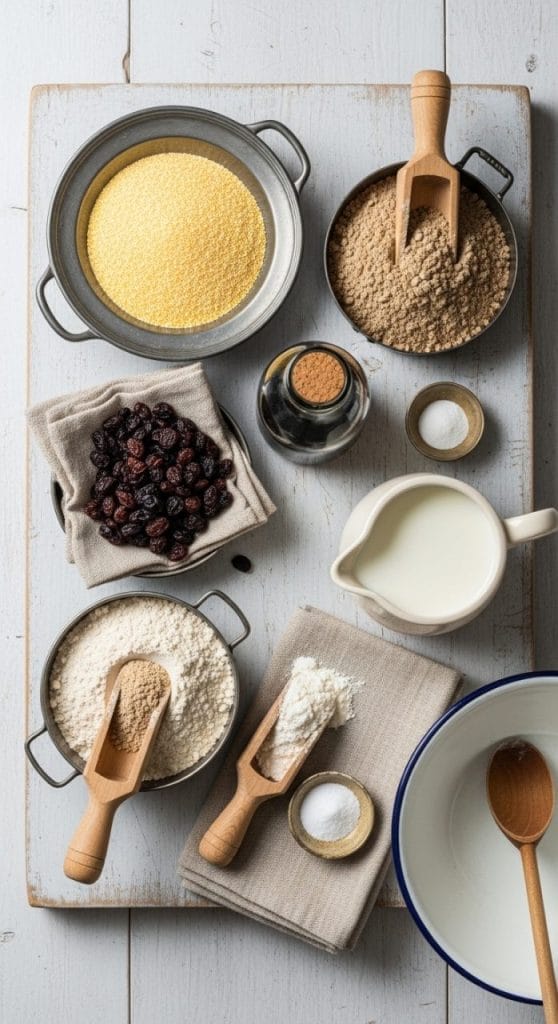
Ingredients
- 1 cup medium-grind cornmeal (yellow or white)
- 1 cup rye flour
- 1 cup whole wheat flour
- 2 teaspoons baking soda
- 1 teaspoon fine salt
- 3/4 cup dark molasses (unsulphured)
- 2 cups buttermilk
- 1 cup raisins (optional, traditional)
You will also need a 1-pound coffee can, 2-quart pudding basin, or three small (15 oz) cans, plus a lidded pot deep enough to hold the mold with water halfway up its sides.
Instructions
Step 1: Prepare the Mold
Generously butter the inside of a 1-pound coffee can or pudding basin. Dust with a tablespoon of flour, tapping out the excess.
Cut a round of parchment to fit the bottom and press it in. This keeps the bread from sticking after two hours of steaming.
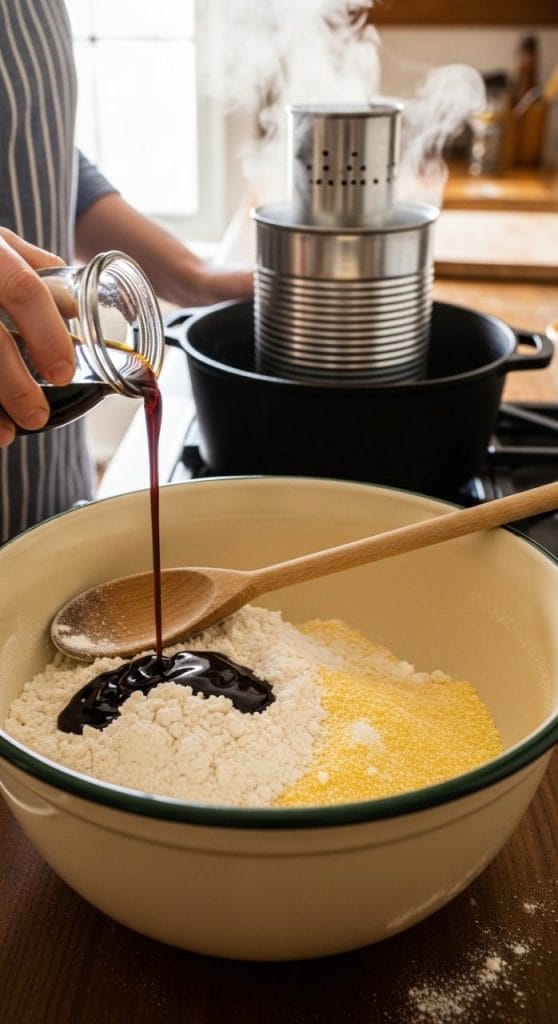
Step 2: Mix the Dry Ingredients
In a large bowl, whisk (this OXO balloon whisk takes a beating) together the cornmeal, rye flour, whole wheat flour, baking soda, and salt.
Break up any lumps in the flour with your fingers. Old stone-ground flours clump and the soda needs to be evenly distributed to leaven properly.
Step 3: Combine the Wet
In a second bowl, whisk the molasses into the buttermilk until fully blended. It takes about a minute. The mixture will foam slightly as the soda in the batter reacts later.
If using raisins, toss them in a tablespoon of the dry flour mix to prevent sinking.
Step 4: Combine and Pour
Pour the wet mixture into the dry and stir just until no streaks of dry flour remain. Fold in the raisins.
The batter will be thick, pourable, and dark brown. Scrape it into the prepared mold, filling no more than two-thirds full. The bread will rise as it steams.
Step 5: Seal the Mold
Cover the top of the can or basin with a round of buttered parchment, then a double layer of foil. Tie a loop of kitchen string around the rim to hold the foil tight.
This seal is what creates the steam chamber inside. Air needs to circulate around the mold, but the bread itself must stay enclosed.
Step 6: Steam for 2 to 3 Hours
Place a folded dish towel or a metal trivet on the bottom of a large lidded pot. Set the mold on top. Pour in boiling water until it reaches halfway up the sides of the mold.
Cover the pot and bring to a gentle simmer over medium-low heat. Steam for 2 hours for small molds, 2.5 to 3 hours for a full coffee can.
Check the water level every 45 minutes and top up with boiling water as needed. Never let the pot go dry.
Step 7: Test and Unmold
The bread is done when a skewer pushed into the center comes out clean or with a few moist crumbs. The top will feel firm and springy.
Lift the mold out of the pot with tongs or a folded towel. Let it cool in the mold for 10 minutes, then run a knife around the edge and turn it out onto a rack.
Slice thickly while still warm.
Tips for a Good Loaf
- Do not skip the buttermilk. The acid reacts with the baking soda to give the bread its lift. Regular milk plus a tablespoon of lemon juice works in a pinch.
- Use blackstrap or dark molasses, not light. The flavor depth comes from the molasses.
- Do not substitute all-purpose flour for the rye or whole wheat. The bread will taste flat.
- Old recipes called for saleratus. That is the 19th-century name for baking soda. Use the same amount.
Serving Boston Brown Bread
Traditionally, this goes on a New England Saturday night dinner plate next to baked beans, salt pork, and coleslaw. The sweet bread balances the salty savory beans.
It is also excellent toasted the next morning with a smear of butter or cream cheese, or cut into thin rounds and stacked with thinly sliced ham.
The bread keeps for five days wrapped in parchment at room temperature, or freezes well for up to three months.
Variations
- With raisins: The most common version. Dark or golden, whichever you have.
- With currants: Tart and more compact. Mid-19th century New England cookbooks often called for currants rather than raisins.
- Without dried fruit: Perfectly traditional and excellent with baked beans.
- With walnuts: Non-traditional but common in 20th-century American home versions. Use 3/4 cup chopped.
Frequently Asked Questions
Can I bake Boston brown bread instead of steaming it?
Technically yes, but it changes the bread completely. Baked brown bread is drier, crustier, and loses the moist cake-like interior that makes it worth eating. If you want baked cornbread, bake cornbread. For brown bread, steam it.
Do I need a coffee can?
No. A 2-quart pudding basin works. Three clean 15-oz soup cans (such as tomato cans) with the paper labels removed also work for smaller loaves and faster steaming.
How do I know when it is done?
A skewer pushed into the center comes out clean or with moist crumbs. The top springs back when gently pressed. If the bread is still wet in the center after three hours, steam another 20 minutes.
Can I make this gluten-free?
Partially. Cornmeal is naturally gluten-free, and you can substitute buckwheat flour for the rye. Replacing the whole wheat is trickier; a 1:1 gluten-free flour blend is the closest swap, though the texture will be more fragile.
Why is my brown bread bitter?
Usually one of three reasons: too much baking soda, blackstrap molasses used where dark molasses was called for, or the mold was not sealed tight enough and the top boiled instead of steamed. Follow the seal step carefully and stick to standard dark molasses.
Can I steam it in an Instant Pot?
Yes. Use the steam function with 1 cup of water in the pot. Seal the lid with the valve open. Steam for 90 minutes for a coffee can, 60 minutes for small cans. Let the bread rest in the pot for 10 minutes before lifting.
Tools That Help
A heavy-bottomed stockpot is essential. The steam method runs long, and a thin pot will scorch the towel at the bottom.
A pudding basin set is the traditional mold and doubles for jam roly-poly, Christmas pudding, and steamed suet (Atora is the British classic for steamed puddings) desserts. A kitchen scale makes the three-flour blend easier to get right, since stone-ground flours can vary by volume.
For background on why pre-industrial kitchens leaned so hard on steaming and hearth cooking, see our guide on what colonial kitchens looked like and how they worked.
This recipe sits alongside the other loaves in our colonial breads roundup. For the broader arc of how American home baking evolved, the cooking history timeline puts Boston brown bread in context with the ovens, stoves, and ingredients that came before and after it.

Maggie Hartwell
Hi there, I’m Maggie Hartwell, but you can call me Maggie—the apron-clad foodie behind Classic Fork! I created Classic Fork because I’m convinced food has a way of telling stories that words can’t. So, grab a fork and dig in. The past never tasted so good!


