
Home > Single Recipes > National Loaf Recipe: The 1942 Victory Loaf That Fed Wartime Britain
Last Updated: July 5, 2026
Classic Fork earns a small commission from Amazon and other affiliate links at no extra cost to you, helping us keep our content free and honest.
National Loaf Recipe: The 1942 Victory Loaf That Fed Wartime Britain
Time Period:
Cooking Time: 40 minutes
Prep Time: 20 minutes
Total Time: 2 hours 30 minutes
Servings: 12 slices
Calories: Approximately 120 kcal per slice
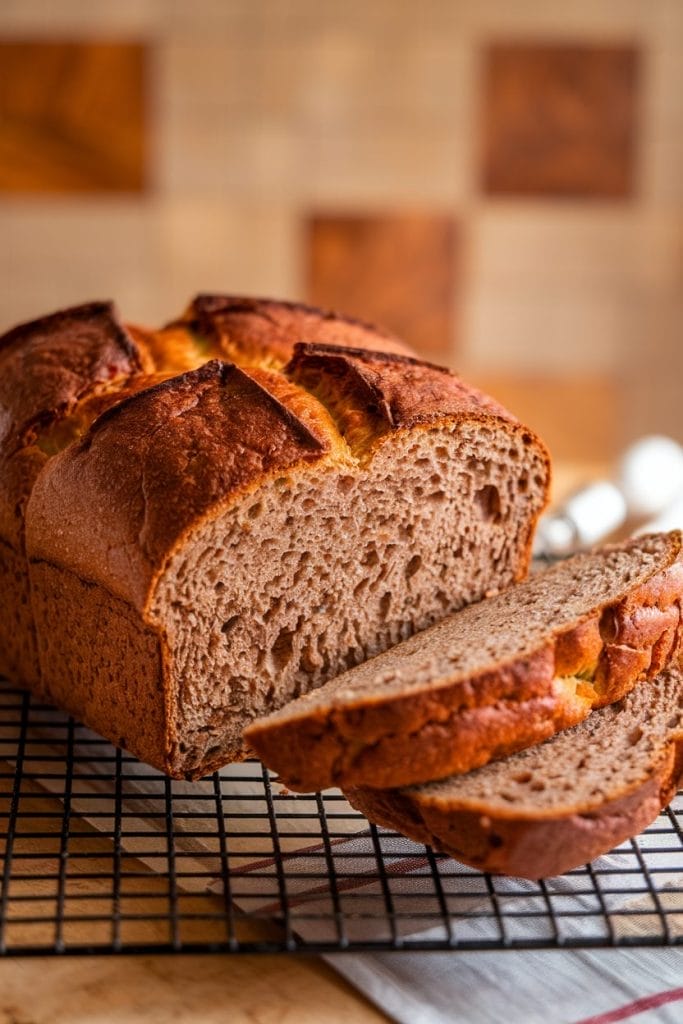
The National Loaf was the bread of British survival. From 1942 until rationing ended in 1956, this dense wholemeal loaf was the only commercially baked bread you could buy in the UK.
I baked one to taste what wartime Britain actually ate. The verdict: surprisingly good, especially toasted with butter and jam.
It is denser than modern loaves, faintly nutty from the bran, and keeps for nearly a week.
What Is the National Loaf?
The National Loaf was a wholemeal bread mandated by the British government in 1942 as part of WWII food rationing. White flour was banned for retail use because milling it wasted nutrients and grain.
Instead, bakers were required to use a high-extraction wholemeal flour (around 85% bran retained), which made the bread denser, browner, and more nutritious than the white loaves people were used to.
It was officially called the “Wheatmeal Bread Order” loaf, but the public quickly nicknamed it the National Loaf. Many Britons hated it at first. Some came to love it. By the time rationing ended, it had outlasted the war by 11 years.
A Quick History of the National Loaf
Britain was importing 70% of its wheat before the war. When German U-boats started sinking supply ships in 1940, that pipeline collapsed almost overnight.
The Ministry of Food had a problem. Stretch the remaining wheat, keep people fed, and somehow add nutrition to compensate for everything else that was rationed.
The solution was the National Loaf, introduced in March 1942. It used 85% extraction flour (versus 72% for typical white bread), which meant more bran, more germ, more vitamins, more fiber, and a darker color.
The government also added calcium carbonate (chalk) to the flour as a calcium supplement, since dairy was rationed. The bread was nicknamed “Hitler’s secret weapon” by critics who hated the texture.
The National Loaf was so unpopular at first that the government ran propaganda campaigns to sell its health benefits. By the end of the war, doctors noted Britons were actually healthier than before, partly thanks to this loaf.
Victory Loaf vs National Loaf vs Government White Bread
You will hear the same wartime bread called by three different names. They are not always the same loaf.
- National Loaf (UK, 1942-1956): The British wholemeal loaf described above. 85% extraction wholemeal flour, calcium carbonate added, mandated by the Ministry of Food.
- Victory Loaf (US, 1942-1946): The American counterpart. The War Food Administration ordered millers to enrich white flour with thiamine, niacin, riboflavin, and iron. Less radical than the British version because Americans never gave up white bread, just made the white version more nutritious.
- “Government issued white bread” (US slang, 1943-1946): A nickname for the enriched white loaf bakers were required to produce. Pre-sliced bread was also temporarily banned in 1943 to save metal in commercial slicing machines.
This recipe gives you the British version. For the American Victory Loaf, use 100% white flour, swap the honey for 2 tablespoons of malt syrup, and the texture lands much closer to a sandwich loaf.
Times and Yield
- Prep time: 20 minutes
- Rise time: 1 hour (first) + 30 minutes (second)
- Bake time: 35-40 minutes
- Total time: ~2.5 hours
- Yield: 1 loaf (~12 slices)
- Difficulty: Beginner
Equipment
- Large mixing bowl (this Pyrex glass set has been on my counter forever)
- Measuring cups (this Pyrex glass set has held up for years) and spoons
- Wooden spoon (this beech-wood set has lasted me a decade) or dough whisk (this OXO balloon whisk takes a beating)
- 8×4 inch loaf tin
- Clean kitchen towel or plastic wrap
- Oven
- Cooling rack (this Wilton 3-tier rack saves my counter on bake days)
Ingredients
- 3 cups wholemeal (whole wheat) flour
- 1 cup all-purpose flour
- 1½ tsp salt
- 2 tsp active dry yeast
- 1½ cups warm water (110°F)
- 2 tbsp vegetable oil or melted butter
- 1 tbsp honey or sugar (optional, helps activate yeast and softens the crumb slightly)
Instructions
Step 1: Activate the Yeast
In a small bowl, combine warm water and honey. Sprinkle yeast on top, stir gently, and let it sit for 10 minutes until frothy.
If nothing happens, the yeast is dead. Start over with fresh yeast.
Step 2: Mix the Dry Ingredients
In a large mixing bowl, whisk together the wholemeal flour, all-purpose flour, and salt.
Step 3: Combine Wet and Dry
Pour the frothy yeast mixture into the dry ingredients. Add the oil or melted butter.
Stir with a wooden spoon until a sticky, shaggy dough forms.

Step 4: Knead the Dough
Turn the dough out onto a lightly floured surface. Knead for 10 minutes until smooth and elastic.
Wholemeal dough takes longer to develop than white. Be patient. Add a bit of flour if it sticks badly, but do not over-flour or the loaf will be heavy.
Step 5: First Rise
Place the dough in a greased bowl, cover with a damp towel, and let it rise in a warm spot for about 1 hour or until doubled. The exact rise time depends on your room temperature, so check our yeast dough rise time calculator to match the rise to your kitchen.
Step 6: Shape the Loaf
Punch the dough down to release the air. Shape into a tight cylinder and place seam-side down in a greased loaf tin.
Step 7: Second Rise
Cover and let rise for 30 minutes, until the dough crests just above the rim of the tin.

Step 8: Bake
Preheat oven to 375°F (190°C). Bake for 35 to 40 minutes.
Done when the bread sounds hollow when tapped on the bottom and the crust is deep golden brown. Internal temp around 200°F.
Step 9: Cool
Cool in the tin for 10 minutes, then transfer to a wire rack. Cool completely before slicing or the inside will gum up.
Tips and Troubleshooting
- Brick-like loaf? Wholemeal needs longer kneading and longer rises than white. Do not skimp on either.
- Crumbly when sliced? Cool fully before slicing. Wholemeal bread is fragile when warm.
- Bitter taste? Old wholemeal flour goes rancid quickly thanks to the oils in the germ. Buy fresh and store in the fridge.
- Too dense? The mix of wholemeal + all-purpose is the trick. 100% wholemeal will always be a brick. The all-purpose adds lift.
Variations Worth Trying
- Authentic 1942 version: Use 100% wholemeal flour. Brace yourself for a heavy, rustic loaf. This is what Britons actually ate.
- Seeded: Add ¼ cup mixed seeds (sunflower, flax, sesame) for nutrition and texture.
- Honeyed: Bump honey to 2 tbsp for a slightly sweeter, softer crumb.
- Sourdough variation: Replace yeast with ½ cup active sourdough starter and add 30 minutes to each rise.
How to Serve It
The wartime way: thick slice, a thin smear of butter or marmalade, served alongside a bowl of soup or stew.
Modern: makes excellent toast for avocado, eggs, or a sharp cheddar sandwich. The dense crumb holds up to heavy fillings.
How to Store and Reheat
Store in a paper bag or airtight container at room temperature for up to 5 days. Wholemeal bread keeps longer than white because of the oils in the bran.
For longer storage, slice and freeze. Toast straight from frozen.
Frequently Asked Questions
What is the National Loaf?
A wholemeal bread mandated by the British government during WWII rationing. Introduced in 1942, it used high-extraction wholemeal flour to stretch wheat supplies and add nutrition to a rationed diet.
Why was white bread banned in WWII Britain?
White flour wasted up to 30% of the wheat grain (the bran and germ). With imports cut off by U-boat blockades, Britain could not afford the waste. Wholemeal flour used the entire grain.
Why did the British hate the National Loaf?
It was denser, darker, and grayer than the soft white bread they were used to. It was nicknamed “Hitler’s secret weapon” by some. The Ministry of Food ran ad campaigns to convince people of its health benefits.
When did the National Loaf end?
White flour returned to UK shops in 1956, when bread rationing finally ended. The National Loaf had outlasted the war by 11 years.
Is the National Loaf healthier than white bread?
Nutritionally, yes. The wholemeal flour retains B vitamins, fiber, and minerals stripped from white flour. The added calcium carbonate (a wartime addition) compensated for rationed dairy.
Related Wartime Recipes
- Victory Bread — the American grain-blended wartime equivalent
- Woolton Pie — the famous British WWII vegetable pie
- Dripping Sandwiches — the classic National Loaf companion
- 5 Classic British WWII Recipes — the full roundup
Nutrition
Approximate nutrition per slice:
- Calories: 120
- Carbohydrates: 20g
- Protein: 4g
- Fat: 3g
- Fiber: 3g
- Sugar: 1g
- Sodium: 250mg

Maggie Hartwell
Hi there, I’m Maggie Hartwell, but you can call me Maggie—the apron-clad foodie behind Classic Fork! I created Classic Fork because I’m convinced food has a way of telling stories that words can’t. So, grab a fork and dig in. The past never tasted so good!


